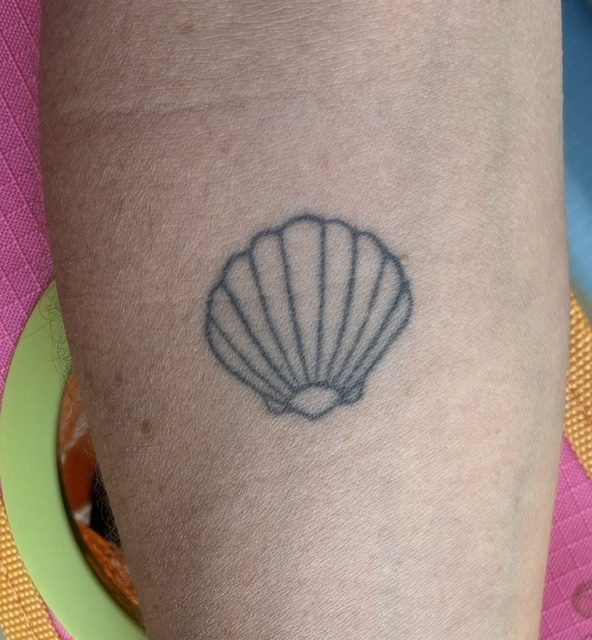
The Camino chose me before I decided to take this trip. A shell tattoo is a popular commemoration of having completed the Way of St. James (Santiago). The trails and paths are marked throughout Spain by the scalloped shell. But I got this tattoo almost 3 years ago. By accident? Or was it a sign? Let’s back up a bit…
I am not original in any way in wanting to walk the Camino de Santiago. Rates of tourism on the Way have skyrocketed in recent years, and who does not love or wish to go to Spain? While most “pilgrims” walk for loose conceptions of spiritual purposes, a commitment to Catholicism is probably growing more unique these days. People are doing ultra marathons and long-distance hikes in enormous numbers and all over the world.
However, my journey did not start with the tattoo. I studied Spanish and completed a study abroad in Málaga, Spain in 2006. I had the time of my life and was in love. Always a lover of history, I went for a Masters in history but without a plan of study. My advisor turned me towards researching Spanish Civil War exiles in Mexico, particularly a gendered perspective. I found the topic so intriguing and essential to understanding European and global history. I knew for the PhD I wanted to continue a transnational approach to the Spanish Civil War. There were not many historians of modern Spain in the U.S., and a mentor gave me the contact for Dr. Aurora Morcillo at FIU, who was a historian of gender and Franco Spain. Aurora quickly asked me to call her cellphone and was enthusiastic to invite me to come to Miami to study with her. From Spain, Aurora was the warmest advisor I could hope for, and incredibly creative and intellectually stimulating. My dissertation evolved into a feminist reading (the theoretical framework of the “nomadic subject” by Rosi Braidotti) of US women’s writings and activities related to witnessing the Spanish Civil War, as well as its legacy of exile and antifascism.
Before I completed my dissertation, Aurora tragically passed away. I was not the only student or colleague that was devastated. In addition to her utterly heartbroken family, the whole department at FIU, and far beyond, felt this tremendous, gut-punching loss. She was a friend and mentor, as much as a colleague. She was a beacon, as much as a professor. I finished the dissertation a year later and always felt a conviction to keep her guiding light and lessons with me, as a teacher, a scholar, and a human.
I struggled with the application of this. I have a huge intellectual awareness of the suffering of peoples, the desire for equality, shared humanity, finding universal truths that bind various religions, worldviews, and spiritualities together. But I have always been stuck in my head, disconnected from others and from myself. I’ve shied away from the uncomfortable yet rewarding intimacy of being -in symbolic terms- down in the dirt with others. I’ve tried internal transformation through on-and-off therapy, self-help books, exercise, and the outdoors, all to try and overcome anxiety, low confidence, and negative thought patterns, all of which can limit living and showing an authentic self.
I was visiting an ex at the beach, a long-distance relationship that would prove too distant to last, and he decided to get a tattoo. Since Aurora’s passing, I had been thinking of getting a memorial tattoo: a quote or a sunflower, sunflowers being abundant in Spain. On Instagram, I saw an artist who did nice fine lines. I decided to go with the quote that Aurora had as her Facebook profile picture, “another past is possible” in Spanish (“otro pasado es posible”). It was small and did not meet the price minimum. In browsing her posts for a second piece, I saw someone with a cute, delicate scallop shell. Perfect! I love the beach (grew up in Ft. Lauderdale) and appreciate the meanings associated with shells: femininity, fertility, etc. It was largely decorative, I was not thinking of the Camino.
I struggled with accepting that breakup and for a long time ruminated over what I did or got wrong; it was unbearable and forced me to more seriously think about radical transformation. I had been stopped a couple of times by strangers asking if I had completed the Camino. My tattoo was giving away a fib I didn’t realize I had committed. After being stopped the first time, I realized the connection between the shell and the Camino. When I attended Aurora’s memorial service, a full 3 years after her passing, another professor also inquired about my shell. I admitted, “No, I’m a fake. I have never done the Camino, but it sounds awesome. Maybe someday!” She illuminated for me, “you do know that Aurora did the Camino? It was the last trip she took students on… and said she would never do it again.” She laughed at the imagined stress of accompanying college students on such a quest. Wow. Ok, now I must do the Camino!
I was hoping to somehow make it work despite a tight/non-existent budget. I talked about this dream with the Director of Global Programs at Providence Day School. I was already on track to earning a Global Educator Certificate. The program culminates with a trip abroad (sans students) and it may be as an individual or with other faculty. Before being approved for this one-time solo travel, candidates have to take online classes and complete the IDI (Intercultural Development Inventory). The followup discussion of my IDI results with my Global Programs Director exposed some deep, internal work I had wanted to do but hadn’t realized yet. The conversation was part professional, largely personal. She encouraged me to propose the Camino as my program trip. I did, and my application was accepted. The trip is mostly covered by the Desoer Grant at PDS. I am eternally grateful. This trip would have been years down the road had the Director not been so supportive and open-minded. My parents were also supportive and excited for me, helping me out, as well. (Next goal, get my dad out on a Camino!)
In addition to building confidence, staying present, and allowing myself the vulnerability to be authentic and create deep connections with others, there have been other signs for me to solo hike through northern Spain. Last year, on a Holocaust education trip to Poland, I spotted a Camino way maker, roughly 3,000 km away.
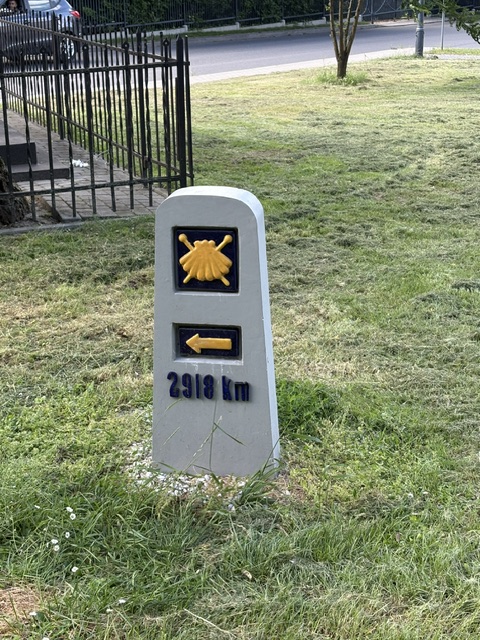
Łańcut, Poland
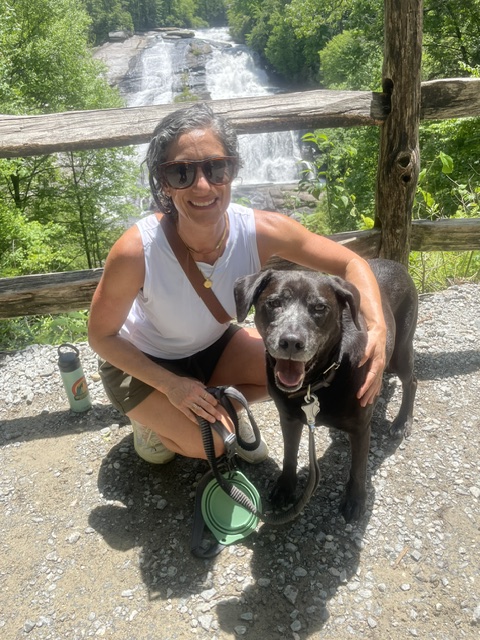
A book I picked up last month, Redemption Road: Grieving on the Camino, written by a Jesuit priest (Brendan McManus), has turned out to be quite apt. Larry, my best friend and hiking companion, passed away 2 weeks ago. As an older dog, there was uncertainty about his condition from when I started planning this trip. But I had not expected to be doing my own grieving on the Camino. I’ll bring a memento of him so that he can walk one more adventure with me.
Half a million pilgrims will walk the Camino this year. I am another tourist jumping on that bandwagon. But starting my journey at the French-Spanish border (the towns of Hendaye and Irún) will have yet another symbolic, full-circle meaning. During my MA, I stumbled onto a memoir, Dancer in Madrid by Janet Riesenfeld. She captivated me. As a young woman from the US following love (a Catalan fiancé) and a career in flamenco in Spain in 1936, the Civil War (1936-1939) broke out. Her early pages describe her tenacity in crossing the precise border that I will begin my Camino. She was desperate to get to the Spanish side, Irún. She passed as a war journalist. She transformed herself to break down imposed, imagined borders. This is what the “nomadic subject” does. For my MA thesis, I had put the memoir aside; it didn’t fit. But, Aurora said that this was my dissertation: the American woman seeking freedom, love, curiosity, adventure, and fulfillment in the traversing of borders, in the traversing of Spain.
Pilgrimage is an act and process of letting go, of stripping you bare. Whether Catholic, Jewish, Muslim, or another religion, pilgrims or walkers are engaged in a human activity of searching for a higher connection, crossing borders, collective movement, communalism; yet, it’s a solitary climb with dependency on the charity of others… Many people describe feeling lighter after the Camino, detaching from what doesn’t serve them, detaching from materialism. I hope to let go of much baggage on the Way while gaining so much more. This takes me to the plethora of pilgrimage studies, and maybe a future blog post. In the meantime, buen camino.
What is something you’ve done with purpose that you’re proud of, or felt signs pointing you in a particular direction?
Peace and happy hiking,
Maria

